Find out how to display local weather to your signs in this tutorial.
SignageNow Server Q&A
Q1:
My sign showed "downloading", but turn to a black screen or still plays old contents.
A1:
- An IP was not received by the device or there is no internet connection to the device.
- There is no playlist assigned to the unit.
Q2:
It showed downloading 1 of x, but now it is a black screen.
A2:
- Content is still downloading, check ‘report’ under the log tab for percentage completed.
- Playlist time has expired.
Q3:
I uploaded all my files, but I can't not find them.
A3:
Uploaded files need to be given a name. If you have not given the file a name, under the upload tab, to the right of ‘My Media Library’ there should be a section with ‘Position’, ‘File’ and ‘Name’. Make sure the ‘Position’ is correct, click the down list arrow, files uploaded for this position should be there. Select each file at a time to assign a name or select all files at once. After giving the file a name, click update and the file will be added to ‘My Media Library’. File names can be arbitrarily assigned or the uploaded name can be used.
Q4:
I can’t delete certain content files from my Library.
A4:
Files need to be removed from all playlists before they can be deleted.
Q5:
I added a new playlist but its still playing the old content.
A5:
Make sure you have the correct time setting for the new playlist. When changing playlist, time settings are cleared.
Q6:
I want to install digital signage software on my PC to manage my digital displays. I don't want to use web-based solutions.
A6:
Another word for Web-based is "cloud computing" which has become the trend of today's technology. The mobility of the platform allows us to provide better services and supports to our clients via one internet portal. Our clients will not need to hire dedicated technician or engineering professionals to manage their signages. Moreover, web-based solution also provides clients the ability to centralize remote control and manage all their signs at multiple locations.
On the other hand, using a PC software solution might seem convenient at first glance, however there are many unforeseen issues such as compatibility, stability, virus & malwares, as well as all types of version updates...etc. Overall, it is not an ideal solution for commercial digital signage usages.
Lastly, clients who worry about binding their services to our hosting servers also have the option of using our partner's hosting services for a small fee, or host their own servers with the MS-Series Sign Servers.*
Q7:
My firewall/Router has port forwarding to build web server (port 80), can I still use MS-1000?
A7:
No. With the same external IP, the port forwarding can only assign each port a server, which won’t allow two or more servers. MS-1000 uses port 80 of web server, so if your firewall/router has dominated web server (port 80) for other application, then MS-1000 won’t be able to use it with object router/firewall...read more
Q8:
What type of video/audio format does your media system support?
A8:
Corn Digital's Media System supports various video / audio format including jpg., bmp., mpg., vob., avi., wmv., mp4., ac3., pcm., mp3., mov...etc. Here's a complete list of all the support files...read more
Q9:
Why is it better to use Portrait LCD display?
A9:
It is important to use Portrait Display because the deposition of the heavy mercury will result in homogeneous color performance and lamp reliability...read more
Q10:
How do I add a non-US weather location?
A10:
Non-US location code can be found in on weather.yahoo.com -> Click RSS -> Right click select view source -> Locate location code -> Add on SignageNow server
Our MS-Series Sign Servers solution is ideal for anyone looking to have a reliable, efficient network of signage. In addition, you also receive your own domain that makes you completely independent of Corn Digital (SignsOnTV.signagenow.com). The UI SignageNow is a web-based application that allows you to manage your content via web. Like I mentioned before, we’re one company that provides a “total solution”, this is good for you because there is no need to make any additional purchases from different companies so if there is an issue you can call one number and get all your questions answered.
My firewall/Router has port forwarding to build web server (port 80), can I still use MS-1000?
A7:
No. The reason is that with same external IP the port forwarding can only assign each port a server, which won’t allow two or more servers. MS-1000 uses port 80 of web server, so if your firewall/router has dominated web server (port 80) for other application, then MS-1000 won’t be able to use it with object router/firewall.
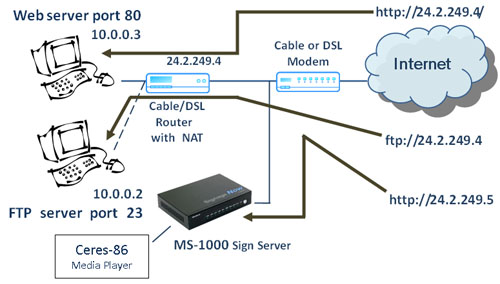
Example given as above, when router (24.2.249.4) received http request, it will forward to web server (10.0.0.3), upon receipt ftp will forward to ftp server(10.0.0.2), through router’s port forwarding, user can use LAN from this router to build http (web) server and ftp servers.
Suggestions : MS-1000 has to have a dedicated IP (Shown as following), MS-1000 includes firewall/router features, which will open the necessary port as needed. It's not like PC server which has to use firewall for protection all the time.
Related information:
Ports: Applications running on TCP/IP open connections to other computers using something called ports. Ports allow multiple applications to reside on a single computer - all talking TCP/IP. Ports are another set of numbers AFTER the standard IP address. Applications often hide these port numbers to reduce the complexity of TCP/IP. Example: web services (HTTP) reside on port 80 by default. To reach this web site, you could type http://www.homenethelp.com:80 into your browser. The 80 is the default port number for the HTTP protocol so typing it is not necessary. There are 65535 available ports.
Port Forwarding: A broadband router or other NAT application creates a firewall between your internal network and the internet. A firewall keeps unwanted traffic from the internet away from your LAN computers. A ‘tunnel’ can be created through your firewall so that the computers on the Internet can communicate to one of the computers on your LAN on a single port. This is handy for running web servers, game servers, ftp servers, or even video conferencing. This is called port forwarding. One of your computers could run a web server (port 80) while another computer could run an FTP server (port 23) - both on the same IP address.
DMZ: This is a feature that is included on some routers but is not in Internet sharing software. A DMZ allows a single computer on your LAN to expose ALL of its ports to the Internet. When doing this, the exposed computer is no longer ‘behind’ the firewall.
Port Forwarding vs DMZ
A DMZ is far easier to set up than port forwarding but exposes your entire computer to the Internet. Sometimes TCP/IP applications require very specialized IP configurations that are difficult to set up or are not supported by your router. In this case, placing your computer in the DMZ is the only way to get the application working. Placing a computer in the DMZ should be considered ‘temporary’ because your firewall is no longer able to provide any security to it.
Port forwarding can sometimes be difficult to configure, but provides a relatively safe way of running a server from behind a firewall. Since only a single port (or small series of ports) is exposed to the Internet, the computer is easier to secure. Additionally, port forwarding allows you to run multiple kinds of servers from different computers on your LAN.
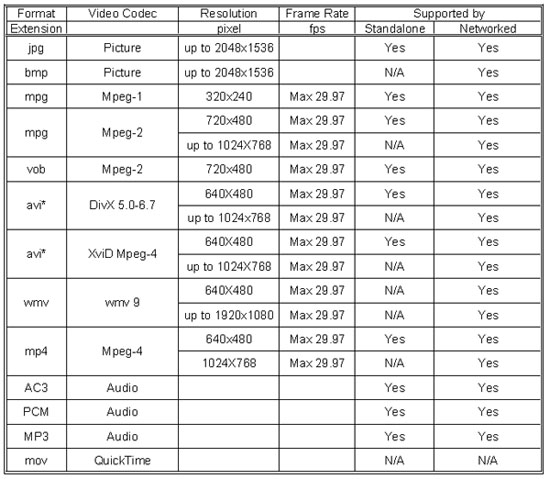
What type of video/audio format does your media system support?
A8:
Corn Digital's Media System supports various video / audio format including jpg., bmp., mpg., vob., avi., wmv., mp4., ac3., pcm., mp3., mov...etc. See below for the complete list of the formats we support:
CORN DIGITAL Media System Supported Video / Audio Format
* The AVI (Audio Video Interleaved) format is not really a proper file format. Rather, it is a so-called container, where the conventions for transferring audio and video files to the program are only loosely defined. A codec compresses audio/video data into its own unique format, which can only be read by the codec itself and is decoded when the movie is actually played
There’s a 30~40% lamp life degradation when switching from landscape to portrait direction. Thus, changing the direction of the CCFL becomes important because it will improve the deficiency of portrait mode’s lamp life!